
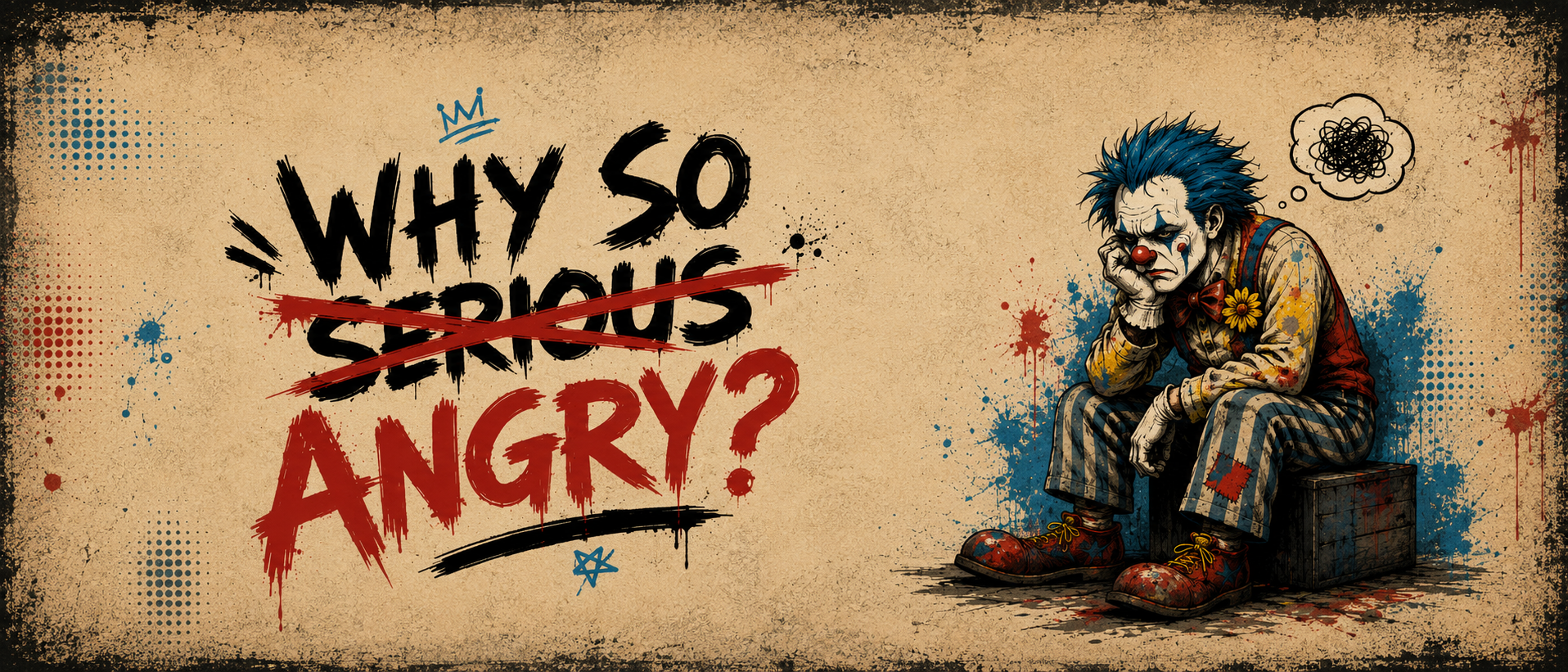

Why So Angry?
By Michael “Maj” Allen
As a touring musician, you often find yourself in close quarters with the same people for extended periods of time. Buses, dressing rooms, backstage hallways, hotel lobbies, airports, vans, catering rooms, soundchecks, and late-night rides all become shared space.
Over the years, you learn a lot about people.
You learn their fears, convictions, quirks, disciplines, and habits. You learn who needs quiet in the morning, who needs coffee before conversation, who processes out loud, and who disappears when the day has been too much. You also learn how people handle conflict, especially when everyone is road-weary.
Fatigue has a way of thinning the emotional walls.
It can make grown people feel like toddlers after a long day at a theme park. We have all seen it. Two weary toddlers in the back seat of a minivan, and all it takes is one child looking in the general direction of another. Suddenly, invisible tension gathers like a tornado, and an argument seems to manifest out of thin air.
Adults are not always that different.
When we are pressed, tired, insecure, misunderstood, disappointed, or uncomfortable, something ancient in us wants to react before we reflect. Often, the person receiving our anger is not the true source of it. They are simply the person standing closest to the overflow.
Career disappointment can turn into impatience at home. Relationship loss can turn into suspicion toward a friend. Private insecurity can become public criticism. Financial pressure can make a harmless comment feel like an attack. And sometimes, like the weary toddlers in the back seat, the real issue is not the person beside us. The real issue is that something inside of us is tired, hurting, or unresolved.
That tendency is as old as humanity itself. Cain was pressed. Life became uncomfortable. His internal world was disturbed. And his reaction was to turn on his brother Abel, even though Abel was not the source of his consequences.
That story may be ancient, but the reflex is modern.
When we feel pressure, we often look for somewhere to send it. When we feel exposed, we look for someone to blame. When we feel threatened, we may reach for anger before we reach for understanding.
I have been fortunate to walk with the artist TobyMac for decades, and one thing that has consistently struck me is the way he manages conflict. There is an immediate default toward curiosity rather than a quick hammer of condemnation. It is not avoidance. It is not passivity. It is not pretending the offense did not happen.
It is something far stronger.
It is the tendency to pause long enough to consider the whole person before responding to the one moment.
I have heard him ask questions like, “I want to understand what led them to take those actions.” Or, “I want to factor in their timeline.” Or, “What else might be going on in their life that produced this decision?”
That kind of response is rare.
Most of us are tempted to build the courtroom immediately. We gather the evidence that supports our hurt. We assign motive. We prepare our closing argument. Before the other person has even had the chance to explain, we have already reached a verdict.
But I have watched a different reflex at work.
In many situations, the choice to lead with curiosity has produced healthy dialogue and understanding instead of the ongoing mudslinging that so often grows out of conflict. Not every situation becomes easy. Not every offense disappears. Not every person is innocent. But the conversation begins from a better place when the first question is not, “How could they do this to me?” but, “What else might be true here?”
That is a display of being slow to anger in real time.
I have come to understand that this is not weakness. It is self-command. It is the disciplined pause between what happened and the story we are tempted to tell ourselves about what happened.
In that pause, curiosity has a chance to speak.
Instead of rushing to, “This is what they did to me,” we might ask, “What else could be true here?” “What pain, fear, misunderstanding, exhaustion, insecurity, or pressure might have produced this moment?”
That question does not excuse the behavior. It does not remove accountability. It does not mean we ignore patterns, tolerate harm, or pretend boundaries do not matter. But it can keep us from becoming prisoners of our first interpretation.
That matters because anger is not merely a mood. It is a whole-body event.
Modern research continues to show that anger affects more than our tone. It affects the nervous system, the heart, the blood vessels, and the quality of our judgment. A 2024 study supported by the National Institutes of Health and led by researchers at Columbia University found that even a brief episode of anger can impair the ability of blood vessels to function properly. In other words, anger does not just pass through the mind. It leaves fingerprints in the body.
So perhaps being slow to anger promotes layers of health: physical, emotional, relational, and psychological. It gives the body time to settle, the mind time to widen, and the soul time to choose a response instead of simply releasing a reflex.
That may be why ancient wisdom advises that immediate anger should never become the default reflex. Being slow to anger is not merely moral advice. It is a healthier way to live.
Curiosity does not excuse harm; it slows down the verdict.
And sometimes slowing down the verdict is what keeps us from punishing people for motives they never had, stories we never confirmed, and conclusions we reached too quickly.
The goal is not to become a person who never feels anger. The goal is to become a person whose anger has to pass through wisdom before it becomes a decision.
Because anger can be a signal. It can reveal that something matters, that a boundary has been crossed, or that a wound has been touched. But anger is not always a reliable narrator. It may tell us that something hurts, but it may not tell us the whole truth about why.
We can think of it this way: the first version of the story may be loud.
But it may not be true.
If these reflections stirred something in you – if you recognize anger that feels unresolved, misplaced, or difficult to explain – I do not want to leave you sitting with that alone.
Sometimes anger is not the real issue. Sometimes it is the smoke from something deeper: grief, disappointment, fear, rejection, exhaustion, or an old wound that never received language. If that is where you find yourself, I have gathered resources and conversations that may help you begin sorting through what is beneath the surface.
You can visit www.djmaj.com/talk as a starting place.
Not because every answer will arrive at once, but because healing often begins when we stop pretending we are fine and become curious enough to ask what our anger has been trying to tell us all along.
Source Note:
The research referenced above is from a 2024 NIH-supported study led by researchers at Columbia University on anger and blood vessel function. NIH Research Matters: Anger may harm heart and blood vessel health.